
 kevin clarke
Introduction: In IGRT, Precision Must Be Seen—Not Just Achieved
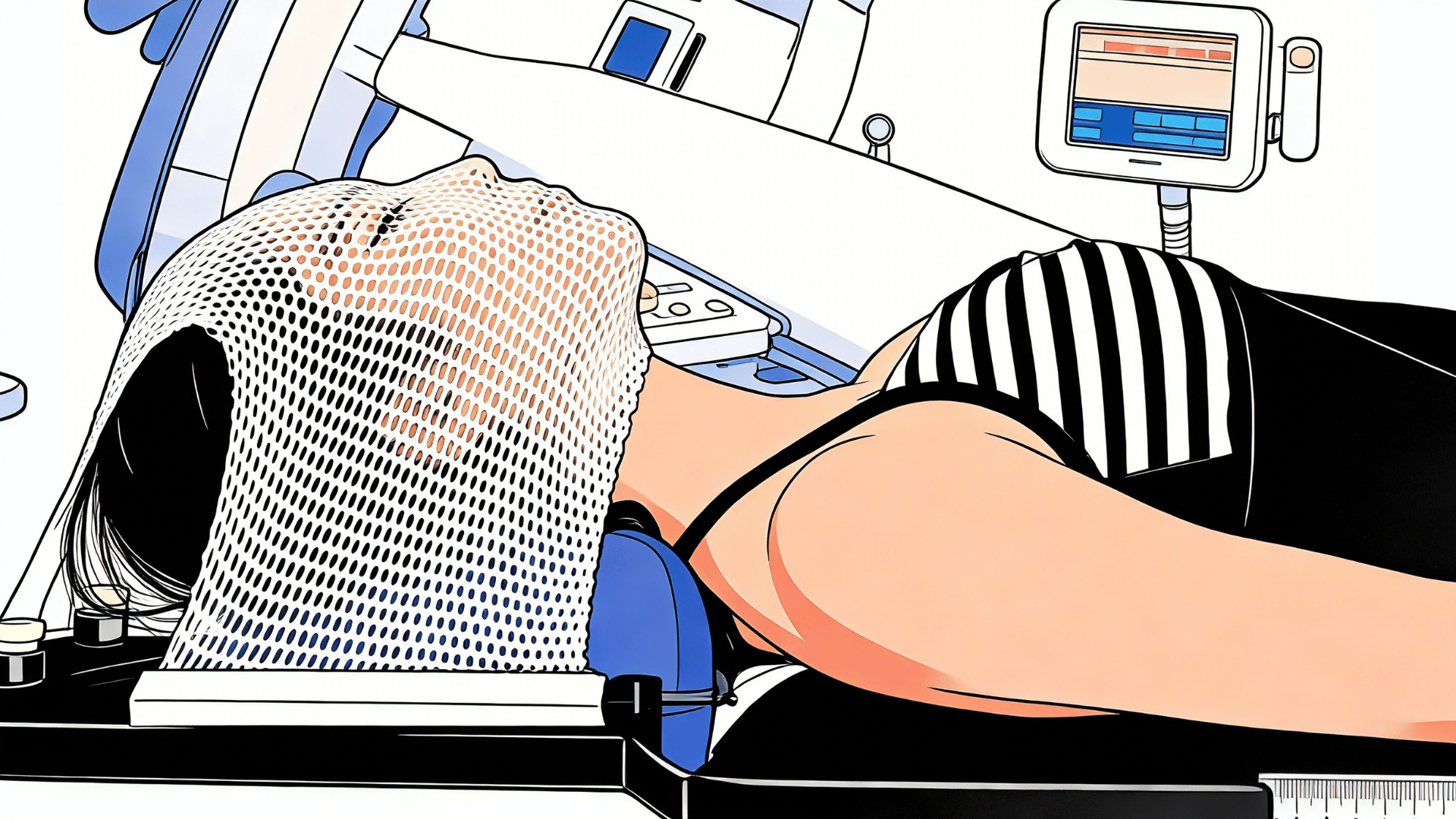
In the era of Image-Guided Radiotherapy (IGRT), patient immobilization is no longer evaluated solely by how accurately it restricts motion. It must also be imaging-transparent.
A thermoplastic mask that fits perfectly but introduces imaging artifacts can compromise target delineation, distort anatomy, and ultimately affect treatment accuracy. As imaging becomes central to treatment planning, verification, and adaptation, immobilization devices must support not only mechanical precision—but visual clarity.
The Problem of “Artifacts” in Imaging
Why Do Some Thermoplastic Masks Create CT Artifacts?
CT artifacts—such as streaking, shading, or localized distortion—often originate from inhomogeneous or contaminated materials within the imaging field.
Common causes include:
- High-density fillers or impurities
- Non-uniform polymer composition
- Embedded additives with elevated atomic numbers
When X-rays pass through these materials, differential attenuation leads to beam hardening and reconstruction errors, appearing as streak artifacts in CT images.
The Role of High-Z Impurities and HU Distortion
Materials containing high atomic number (high-Z) elements disproportionately attenuate low-energy photons, artificially elevating measured Hounsfield Unit (HU) values.
This can result in:
- Incorrect tissue density representation
- Errors in electron density mapping
- Dose calculation inaccuracies in treatment planning systems
Even small deviations in HU values can be clinically significant in high-precision treatments such as IMRT, VMAT, SBRT, and SRS.
The Solution: Material Purity and Intelligent Design
Medical-Grade Polymer Purity
High-quality thermoplastic masks are manufactured from medical-grade, high-purity polymers, carefully formulated to ensure:
- Homogeneous composition
- Consistent radiological properties
- Predictable attenuation behavior
By eliminating unnecessary fillers and high-Z contaminants, these materials achieve low X-ray attenuation and near-tissue-equivalent imaging characteristics.
The result is a mask that becomes virtually “invisible” on CT—supporting accurate contouring and dose calculation.
MRI Compatibility: Designing for the MR-Linac Era
Why Non-Metallic, Non-Magnetic Materials Matter
With the increasing adoption of MR-Linac systems, immobilization devices must meet stringent MRI compatibility requirements.
Key design considerations include:
- Zero metallic components
- Non-magnetic, RF-safe polymers
- Minimal magnetic susceptibility differences
Materials that fail to meet these criteria can cause:
- Image distortion
- Signal loss
- Safety risks in high magnetic fields
MRI-compatible thermoplastic masks enable high-resolution soft-tissue visualization without compromising patient safety or image fidelity.
Dosimetric Impact: Small Attenuation, Big Consequences
Why Sub-Percent Attenuation Matters
From a dosimetric perspective, immobilization devices are part of the beam path. Even modest attenuation can introduce uncertainty.
High-quality thermoplastic masks are engineered to limit beam attenuation to well below 1%, ensuring:
- Accurate dose modeling
- Consistent beam delivery
- Reliable comparison between planned and delivered dose
This is particularly critical in adaptive workflows, where daily imaging and dose recalculation rely on stable, predictable system behavior.
Supporting Adaptive Radiotherapy (ART)
Adaptive Radiotherapy demands:
- Reproducible positioning
- Artifact-free imaging
- Reliable dose calculation
Immobilization materials that distort imaging or introduce dosimetric uncertainty undermine the very foundation of adaptation. Selecting imaging-compatible thermoplastic masks ensures that anatomical changes—not device artifacts—drive clinical decisions.
Conclusion: True Precision Is Invisible
In modern radiotherapy, the best immobilization solution is one that does its job without being seen.
By choosing thermoplastic masks that offer:
- High material purity
- CT and MRI compatibility
- Minimal dosimetric impact
clinics lay the groundwork for accurate IGRT, confident adaptive planning, and future-ready treatment workflows.
Invisible precision is not optional—it is essential.





Hi, this is a comment.
To get started with moderating, editing, and deleting comments, please visit the Comments screen in the dashboard.
Commenter avatars come from Gravatar.